
For the last year, a lot of British Columbians have been asking the same question:
“Can Aboriginal title be declared over my private property?”
This week, the Supreme Court of Canada provided some much-needed clarity.
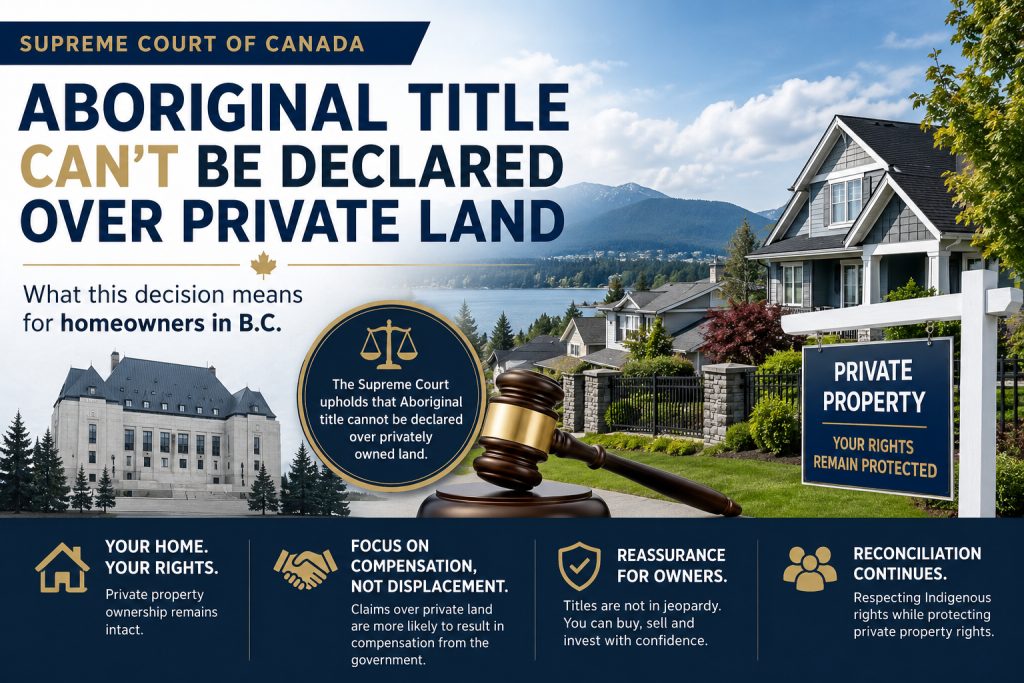
The Court has upheld a New Brunswick Court of Appeal decision that says Aboriginal title cannot be declared over privately owned land. While the Supreme Court did not issue a detailed written judgment, it declined to hear an appeal of the New Brunswick ruling, effectively allowing that decision to stand.
Why This Matters
If you’ve followed the news over the past year, you’ve likely heard about the Cowichan Tribes case in British Columbia.
In that case, the B.C. Supreme Court ruled that Aboriginal title could be declared over lands that included privately owned property in Richmond, B.C. The decision sparked concern among homeowners, businesses, lenders, municipalities, and investors because it raised questions about how private ownership rights and Aboriginal title could coexist.
The ruling created uncertainty because previous Aboriginal title cases had generally focused on Crown land rather than privately owned property.
What the Supreme Court’s Decision Means
The New Brunswick Court of Appeal concluded that courts cannot issue a declaration of Aboriginal title over privately held land because doing so would create two competing claims of exclusive ownership over the same property. The court found those rights are fundamentally incompatible.
Instead, the court said Indigenous groups may still seek compensation or damages from governments if Aboriginal title is established historically over lands that are now privately owned. The focus shifts toward Crown responsibility and reconciliation rather than disrupting existing private ownership.
By refusing to hear an appeal, the Supreme Court has effectively signaled that this approach will remain the law for now.
What Does This Mean for Homeowners?
For the average homeowner, this decision should provide reassurance.
The federal government has already indicated that the ruling will influence arguments in ongoing cases, including the Cowichan litigation in British Columbia, and has stated that it intends to protect private property rights while continuing reconciliation efforts with Indigenous communities.
In practical terms:
- Your home’s title is not suddenly in jeopardy.
- Existing private ownership rights remain intact.
- Future Aboriginal title claims involving private lands are more likely to focus on compensation and negotiations with governments rather than transferring ownership from private landowners.
The Conversation Isn’t Over
That doesn’t mean the broader legal discussion is finished.
The Cowichan decision is still under appeal, and courts across Canada continue to wrestle with how Indigenous rights, historical land claims, and modern property ownership should be reconciled.
What this latest development does provide is a stronger signal that Canada’s highest court is not prepared to endorse a system where private property owners face competing declarations of ownership over the same parcel of land.
Bottom Line
For homeowners, buyers, sellers, and investors, the sky is not falling.
The Supreme Court’s decision reinforces a principle that most Canadians have long assumed: privately owned land remains privately owned. Indigenous rights claims remain an important part of Canada’s legal landscape, but the preferred path for resolving historical grievances appears increasingly likely to be compensation, negotiation, and reconciliation—not the displacement of existing private property owners.
As the Cowichan appeal and other title cases continue to work through the courts, we’ll undoubtedly see more debate. But for now, the message from Canada’s highest court is clear: declarations of Aboriginal title and private ownership are not intended to occupy the same piece of land.